
Conversations Behind the Research: Reflections from WiNUK Day 2026
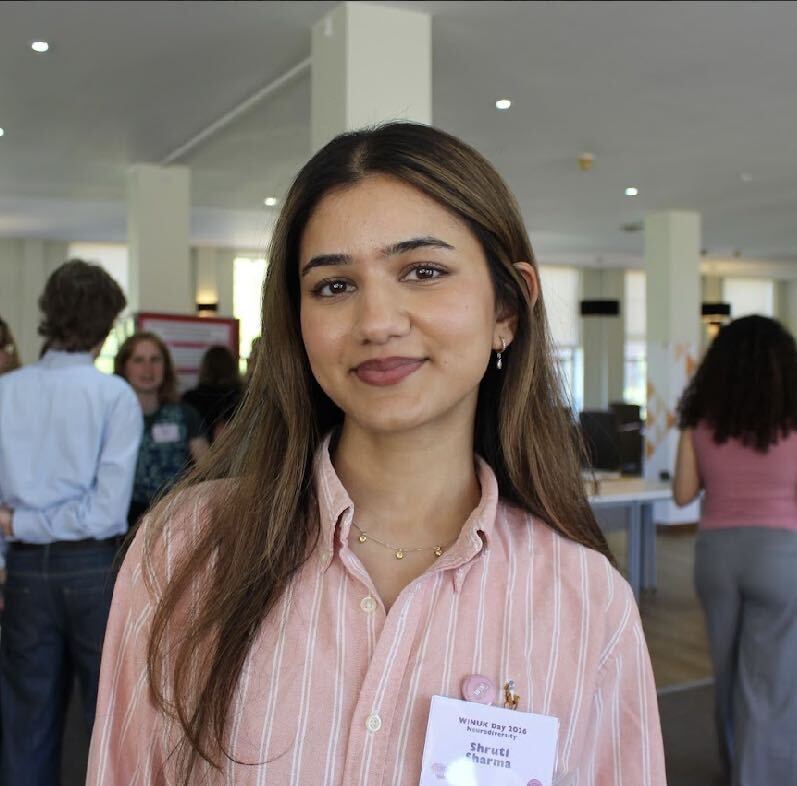
"It's amazing how much you can learn from a five-minute conversation."
That was the thought I found myself returning to throughout WiNUK Day 2026.
Having joined WiNUK earlier this year as an Operations Executive, this was my first opportunity to volunteer at one of our flagship events. Before the talks had even begun, there was already a buzz around the University of Birmingham's Staff House. Fellow volunteers were setting up, speakers were arriving, and researchers from across the UK were beginning to fill the room. It was exciting to see so many people brought together by a shared interest in neuroscience and, more importantly, by a shared commitment to making it more inclusive.
If I had to summarise the day in three words, they would be informative, connection and research.
Conversations that changed my perspective
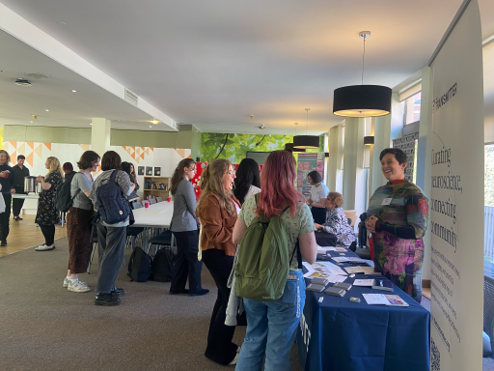
Most of my day was spent at the WiNUK stand, welcoming attendees, handing out badges and stickers, chatting about WiNUK's mission and encouraging people to join our community.
...improving equity in neuroscience isn't just about who carries out the research or who participates, it's also about ensuring that the tools themselves work for everyone.
One of my very first conversations ended up being one of the most memorable:
I met an industry professional working to make neuroscience equipment more inclusive. They explained that even something as fundamental as an EEG (electroencephalogram) cap isn't always designed with different hair types in mind. Before that conversation, I hadn't considered how seemingly small design choices could unintentionally exclude people from research. It was a reminder that improving equity in neuroscience isn't just about who carries out the research or who participates, it's also about ensuring that the tools themselves work for everyone. It was exactly the kind of conversation I had hoped to have by volunteering.
Throughout the day, I met undergraduate students exploring careers in neuroscience, PhD researchers presenting their work, academics, clinicians and professionals from industry. Although everyone had different backgrounds, there was a common thread running through every conversation: a genuine desire to improve neuroscience through collaboration and inclusion.
Research that challenges assumptions
This year's theme, Neurodiversity, focused on considering sex and gender in neurodiverse conditions and creating a more inclusive research culture.
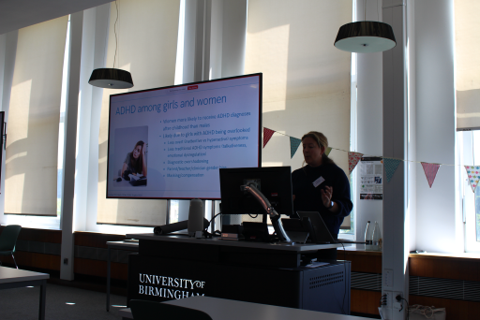
One talk that particularly stood out to me was Dr Jessica Agnew-Blais' presentation on female-specific factors in ADHD (Attention Deficit Hyperactivity Disorder), where she dove deeper into exploring the relationship between hormonal fluctuations and ADHD.
A range of mental health conditions, including depression and psychotic disorders, have been associated with premenstrual exacerbation. Dr Agnew-Blais highlighted that there is also considerable clinical, and anecdotal, evidence from women with ADHD describing their symptoms becoming worse before menstruation, with some women reporting that their ADHD medication feels less effective during this period of time.
What was most striking was that when Dr Agnew-Blais looked at the research behind these experiences, there was very little evidence available. This gap is now being explored through the Measuring Adult ADHD and Menstruation (MAAM) study, which is investigating whether different phases of the menstrual cycle are associated with changes in ADHD symptoms and functioning.
Dr Agnew-Blais also discussed the wider issue of ADHD diagnosis in girls and women. Research from Wales has found that women are more likely to be prescribed antidepressants before receiving an ADHD diagnosis, and are then more likely to discontinue their antidepressants after receiving their diagnosis than their male counterparts. This raises important questions around diagnostic overshadowing, and possibly even misdiagnosis.
It left me thinking about how much neuroscience is shaped not only by the question we ask, but also by who we ask those questions about.
Alongside the keynote talks, the poster sessions and flash presentations showcased an impressive range of emerging research. Walking around the posters during lunch, it was inspiring to see early-career researchers discussing their work with such enthusiasm. The willingness of people to answer questions, exchange ideas and support one another made the event feel less like a conference and more like a community.
The Lost Girls of Autism

The question of representation was also a strong theme in Professor Gina Rippon’s work on autism and her book, The Lost Girls of Autism.
Professor Gina Rippon explored how women and girls have historically been overlooked in autism research, with autism becoming largely defined through a male experience. One particularly striking example was a systematic review of autism research showing that 70% of studies were male-only, while of the more than 4,000 autistic participants across the research examined, fewer than 10% were female.
If the evidence base is disproportionately built around one group, then the people who fall outside of that group can become harder to recognise, diagnose and support. This connected closely with the conversations I was having with attendees at the WiNUK stand. From the design of an EEG cap to the participant included in a research study, inclusion has to be considered at every stage.
The Poster Session
The poster session was another reminder of how broad the field of neurodiversity research is.
One poster, “Study Design for Neurodiversity in Mothers and Birthing People who Access the Perinatal Mental Health Service” explored how experiences of accessing perinatal mental health services can differ between mothers and birthing people, and how neurodiversity can intersect with these individual experiences.
Another poster, “Synaptic Pruning and Autism Spectrum Disorder” took a very different approach, exploring the neuroscience underlying altered neural connectivity in autism. The research considered how both reduced and excessive synaptic pruning can arise from disruptions in molecular pathways, including signalling mechanisms and microglial activation.

Seeing such different research side by side was one of my favourite parts of the day. It was a great illustration of how many perspectives are needed to understand something as complex as neurodiversity.
More than networking
Networking can sometimes sound intimidating, but WiNUK Day felt different.
Whether I was introducing someone to WiNUK, hearing about a PhD project or simply chatting over coffee, every interaction felt genuine. As someone who was still relatively new to the organisation, it was incredibly rewarding to meet the people behind WiNUK and the wider neuroscience community. I left with a much stronger appreciation for just how broad neuroscience is, and how many different people are working towards the same goal of making research more representative and inclusive.

Looking ahead
Volunteering at WiNUK Day 2026 reminded me why organisations like Women in Neuroscience UK matter. They create spaces where important conversations can happen, where research is shared openly, and where people from different backgrounds can connect over a common purpose.

I arrived hoping to help the event run smoothly, but I left with something much more valuable: a new perspective on inclusion in neuroscience, a deeper understanding of the challenges that remain, and a renewed optimism for the future. If WiNUK Day 2026 demonstrated anything, it's that meaningful change often starts with a conversation, and I feel incredibly fortunate to have been part of so many of them.
Disclaimer: All research discussed in this article was taken from the presentations given at WiNUK Day 2026 and, therefore, not referenced here.
This article was written by Shruti Sharma and edited by Rebecca Pope, with graphics produced by Ameesha Gehlot. If you enjoyed this article, be the first to be notified about new posts by signing up to become a WiNUK member (top right of this page)! Interested in writing for WiNUK yourself? Contact us through the blog page and the editors will be in touch.


Comments